

I spoke with Alex Himelfarb for a piece in Jacobin in the fall of 2024. The first edition of his book Breaking Free of Neoliberalism had just come out with the subhead “Canada’s Challenge.” It seemed like an extraordinary time full of challenges, even compared to the previous several years, which had been neither ordinary nor free of obstacles.
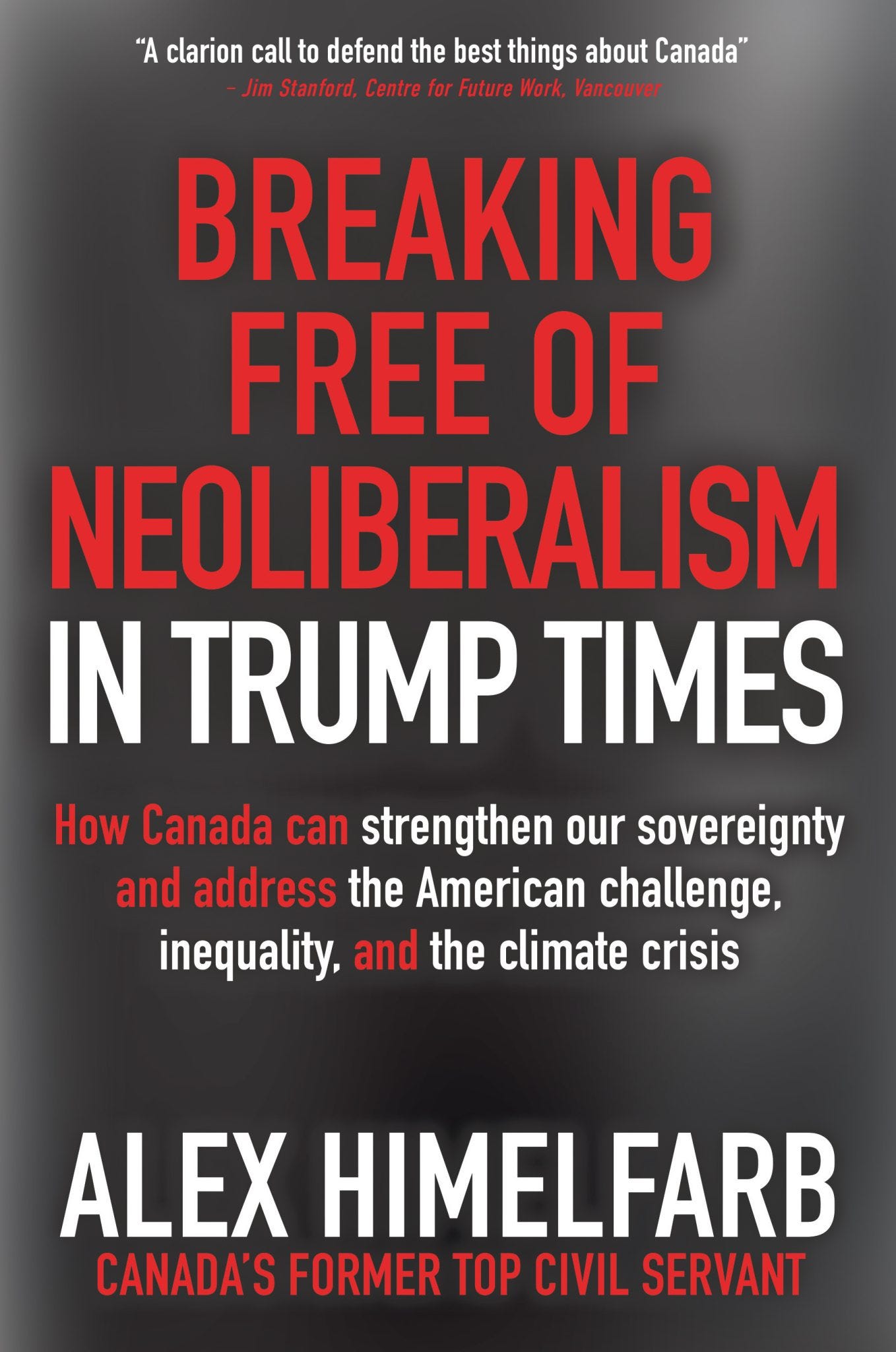
The new edition of the book is out now, reworked, expanded, and updated in light of Donald Trump’s 2024 re-election — a victory ushered in by, among other forces, neoliberalism. Accordingly, the new edition has a new title, Breaking Free of Neoliberalism in Trump Times, which reflects the higher stakes we face in 2026. It’s also got a new subtitle: “How Canada can strengthen our sovereignty and address the American challenge, inequality and the climate crisis,” reflecting just how many problems we’ve got piling up. Remember, kids, it can always get worse.
But while Himelfarb does an expert job at assessing our maladies and their origins, he also offers a cure and a reminder that things can get better, too, if we fight for it.
This interview has been edited for length and clarity.
David Moscrop
Whenever I talk about neoliberalism I start by making sure everyone’s on the same page. So, what do you mean by “neoliberalism?”
Alex Himelfarb
Neoliberalism is a movable feast. You can do it hot or cold. You can do it more or less. You can do it viciously or more kindly. That has led some people to say it’s not a useful concept, but I think it is a useful concept to help us understand how we got here. In its simplest terms, I think of neoliberalism as a single-minded focus on economic growth — as the answer to whatever ails us, and that growth is best achieved by removing as many barriers to profit as politics allows - cut taxes, deregulate, privatize.
In that context, it is more about what government’s for than about economics. The role of the state, then, is to create the conditions under which the market can flourish, to support the market, to extend the market, but not to interfere with the market. Democracy — demands for rights, protections for workers, families and nature, redistribution — acts as a constraints on neoliberal governance which is why neoliberalism has always worried more about too much democracy than too little. Neoliberal governments become managers and custodians of expertise. Democratic and moral questions are reconstituted as technical questions of efficiency and affordability to be answered by technical experts, fiscal economists, trade economists, and central bankers.
Moscrop
The conception of growth seems to be fairly unsophisticated. I often see conceptions of growth as aggregate, of GDP for instance. No one’s asking about distribution. The assumption is, well, the wealth will trickle down.
Himelfarb
The original 1940s neoliberals didn’t actually profess trickle-down economics. This notion of trickle down evolved as political rhetoric because somehow one had to convince people that not just the rich and powerful but everybody would benefit from tax cuts, etc. Neoliberals started out saying, “What we are proposing is good for civilization. There will be pain, inequality is inevitable, even necessary; some will suffer, but it’s worth it to save civilization.” The original neoliberals didn’t say a rising tide would lift all boats. They said some boats sink, some float, some tip over.
As a political project, trickle down became a kind of sales job. It became the argument for why this is all okay, and the justification for putting efficiency over equity, for putting economic efficiency over nature upon which all of us depend, including the economy.
You could sell this notion that efficiency and economic growth trump everything by saying two things. First you’d say the value of that growth will trickle down so all will benefit. Though, of course, what trickled down doesn’t seem to have been wealth, it seems to be something nastier than that.
The other thing you’d say is “Look, all of those things you care about, the cultural and social values, the environmental values, need to be paid for so first we’ve got to grow the economy so we can afford those nice things.” So, social , cultural, and environmental values are always down the waiting list. We’ll get to you, we’ll get to poor people, we’ll get to inequality, we’ll get to sustainability, we will get to the arts, but only when we can grow the economy big enough.” As if those nice things aren’t essential to a strong economy and society.
Moscrop
How did Canada end up with a neoliberal order?
Himelfarb
I think there’s a couple of things. It’s a mistake to ignore the powerful corporate voices. There’s an entire chapter in the book — and, by the way, it’s a great book and you should buy many, many copies [Editor’s note: you should] — called “A Network of Persuasion.” There are a number of people who think, “Oh, neoliberalism was the inevitable response to globalization and changing technologies” and so on. But the investment, the huge amount of money, the hundreds and hundreds of think tanks created through Atlas Network in Canada and elsewhere in the world, suggests that people who saw benefit for themselves in this ideology understood that you had to invest in persuading people of its merits. There was nothing automatic about it. There was rather this powerful network of persuasion.
The well-funded neoliberal think tanks in Canada have built huge credibility and found it really easy to get published in mainstream media. They’re more persuasion tanks than think tanks. And so number one, there’s a lot of money behind the movement. They’ve also gotten really good at persuasion, for instance centering values like freedom, which became the dominating value in the 1960s and ‘70s during the equality revolution. Of course, neoliberals are offering an extraordinarily hollowed out version of freedom — freedom from government, freedom to compete, freedom to lose, freedom to go broke, freedom to be unemployed. But their communication around freedom and against the so-called nanny state has been very effective.
So, there’s this network of persuasion, but then part of it is and has always been geography. When I was a pretty junior guy in government I remember the senior bureaucrats who had very strong relationships with their American counterparts and were really concerned with the shift in the US and UK towards the neoliberal Thatcher-Reagan ideas that we must unleash the economy so we could be more competitive in an increasingly competitive global economy. This was a time when a number of European countries that had been suffering post-war were increasing their productive capacity. Germany, France, others were now much more competitive, and former colonies who had won their independence were asking more for raw materials. Unions had gained huge power and had secured wage increases and benefits. Inflation was on the rise and growth in decline. All of that conspired to lower profits. And so you had the corporate sector really concerned about how you shore up their ability to maintain profits. No longer did it seem that profit and equity could co-exist.
And so there was a huge incentive to join on to this Reagan-Thatcher counterrevolution. For Canada, given our geography and the massive American market right beside us, a lot of these senior bureaucrats became convinced of the importance of guaranteed access to the American market. Brian Mulroney didn’t come into government with a commitment to free trade but he quickly became its champion. And there was a growing consensus that if we did not get guaranteed access to this huge American market and through it to the global market and global supply chains, we would suffer irreparably.
Long before NAFTA, Pierre Trudeau had warned that we had to be wary because we share a bed with an elephant. Then in the 1980s with NAFTA, we decided to get in bed and cozy up, cuddle in closer to the elephant. That’s a big decision, right? And then with Donald Trump’s election, the elephant went rogue and all the warnings from the left suddenly came home, that we should have been warier: we never got the guarantees and we hugely underestimated the non-economic costs of NAFTA, the costs to democratic, cultural and economic sovereignty.
In the end, we were, it seems, pretty desperate to get a deal. When you negotiate from desperation, you lose. And of course the negotiations were highly asymmetrical to begin with. When you need something more than your counterpart, and a more powerful counterpart to boot, you lose. And so we negotiated that deal.
Mulroney had previously killed the Foreign Investment Review Agency, and a number of other policies that constrained foreign investment. Instead of worrying about what foreign ownership meant for the loss of sovereignty, we started worrying about whether we were getting our fair share of foreign direct investment. The more the better. The whole thing got turned on its head. We were no longer asking “What’s the risk of foreign investment?” but “What’s the risk of not getting our share of it?”
That’s a significant turnaround. Obviously, we need some foreign investment. That’s fine. We need some of that capital, but investment for mergers and acquisitions or investment that buys up Canadian firms and then dismantles them or buys up public assets and key resources, none of that grows our economy. It often shrinks our economy and makes us less sovereign.
Moscrop
Have we learned our lesson? It doesn’t seem like it. Officials in Canada talk about a global rupture and the decline of the United States as a reliable partner, but I get the sense that if there were a new American administration tomorrow and we thought we could reestablish the old NAFTA deal or some similar iteration of the CUSMA, we would go for it. Will we fall right back into old patterns given the option?
Himelfarb
I think that’s a perfect question, and I think yes, we have learned a lesson, and yes we’ll still fall into the same old patterns.
Moscrop
That’s very Canadian.
Himelfarb
Carney has been impressive in his efforts to diversify. I don’t know the content of all these trade deals, but in any case, the commitment to diversifying is obviously important. The commitment to trading more with each other internally is also long overdue. The commitment to invest in Canada and a more active role for government to do so, those are positive things. Those choices signal to me we’ve learned something.
At the same time we hear talk about Fortress North America. And a number of corporate voices in Canada seem prepared to make significant sacrifices to get a deal, to do whatever it takes to restore what was before the Trump assault. And they are demanding more of the same – tax cuts, deregulation, privatization, scaling back the public sector.
But what was also clear as negotiations proceeded is that Canadians had had it with being pushed around, had had it with concessions. Canadians had given Carney extraordinary latitude and they obviously put their faith in him. His credentials, his experience, and his demeanor made him the perfect anti-Trump and that won the PM a lot of trust.
But there was a worrying string of concessions leading into these negotiations from the digital tax to the CRTC rules on streaming services to rumors about the online news act to what we did on the border, the Gordie Howe Bridge, and so on, that made it unclear where we were heading. And it seemed like we might make significantly more concessions which would have significantly reduced our policy autonomy, and locked in illegal and destructive tariffs — and all that as just the appetizer for yet more concessions when we renegotiate CUSMA. But it became increasingly became clear as Trumpian demands and insults escalated that these were not trade negotiations so much as an attempt to subjugate.
You could feel a surge of civic nationalism and with it a growing public angst and belief that we should walk away from the table. And no doubt these feelings were intensified by the front row seat we have to the dismantling of American democracy, to plutocracy run rampant, to public institutions subverted to private ends, to the sometimes violent stifling of dissent and the horrific abuse of immigrants. Most Canadians, with the exception of a small northern MAGA rump, understand that all this represents a profound risk to humanity and want no part of it.
And so Carney did the right thing by walking away. Given the risks, it was courageous and it was right. There are costs and there’s going to be uncertainty. But given the chaos of the Trump regime there was going to be chaos anyway. Some people and firms will pay a price, and we’ll have to spend what it takes to ensure they are protected. But saying no to Trump was the right call.
Moscrop
Do you think we’ll change and stay changed? Do you think that Canadians will look at the landscape and say, “Okay, we obviously need to diversify on trade, probably on defense, we need to reassert our sovereignty.” Do you think we’ll look inward and say, “Okay, well, when we’re talking about nation building, we should also talk about the welfare state, equality, and an industrial policy that’s linked to the well-being of workers and their families, not just to corporations?”
Himelfarb
That is the question. I have no idea. I like the answers embedded in your question — investing in the care economy, education, industrial strategy and the energy transition to diversify not just with whom we trade but what we trade, I write in the book that we have put a huge amount of trust in the prime minister, even more than in his party, and we’ve given him extraordinary leeway. I also write that this is totally understandable in a moment of crisis and given the energy, urgency he has demonstrated in his first year and the balancing act he must perform as he navigates the economic attack from without , and conflicting demands and threats of separatism from within.
I get it, but I think too much leeway for a government is a dangerous thing. Governments are at their best when challenged. So let me do a detour. I went back to the literature on disaster capitalism and I reread Shock Doctrine, and I was reminded how often crisis enables an attack on the public sphere. It happens over and over again, that the public sphere comes to be seen as unaffordable and we shift increasingly to the private sphere. We also accept things that would’ve been unthinkable before the crisis. We entertain things we would never have entertained. And the room for debate diminishes. It becomes “What are you criticizing the government for? They need your support. Get behind the government.”
This notion of allowing debate to narrow is really scary to me. We need more democracy, not less in these times of crisis because the decisions we make about what big projects go forward and what we forgo could lock us into the past and narrow our choices for the future. Investors, foreign or domestic, shouldn’t be deciding what we build and what compromises we make. Canadians directly and through parliament should be deciding. We shouldn’t sacrifice democracy in the name of speed. Respecting Indigenous rights and the duty to seek free prior informed consent are not discretionary.
We are not powerless. We are the ninth biggest economy in the world. We have an educated, diverse population We have unique natural resources. And we are reliable. Decades of neoliberalism may have blinded us to the collective tools we used to build Canada. We used to own things together if they were essential to our sovereignty and security or to the public good even if not privately profitable.
But that means we must also have a clear notion of where we want to go, and what we stand for in the world. We haven’t had that conversation. We cannot afford to let the attack of the Trump regime blot out the other “existential” crises and challenges: climate change, record breaking inequality, and the rise of authoritarian and nativist threats to democracy. And even as we build for the long term we cannot afford to ignore the struggles of Canadians right now, especially young Canadians, as they deal with record levels of household debt, the high cost of essentials, a precarious labour market, and limited government protections.
To return to your earlier question: Have we learned a lesson? Will we learn the lesson? We need this conversation. This is no time for us, any of us to be on the sidelines. And thankfully there are some very articulate voices fighting for a Canada less dependent on the US, but also one that is more equitable, sustainable, and democratic.
This is a helpful and interesting interview, but my eyebrows are stuck in my hairline from your mistake in the first paragraph. Donald Trump was not re-elected in 2020, excerpt in his own mind. You might want to correct that to 2024...
I am concerned that Carney remains a true believer in neo liberalism. He has started revving up the privatization express (or it's shadow expression, "public private partnership") and it is clear that "nation building" so far is 1984-speak for more subsidies and fewer regulations for oil and mining companies. I don't see reason to believe more of the poison that gave us the disease is going to cure us.