

You couldn’t find a better word to describe our current state than “complacent.” I’m thinking of our approach to democratic self-government, but you might use the word to describe our behaviour towards any number of practices, institutions, and commitments. But treating democracy as inevitable and irreversible is particularly risky because self-government is anything but set-it-and-forget it. Alas, it would be much easier for us to lose democracy than it was for us to get it. And once it’s gone, well, then things get really bad.
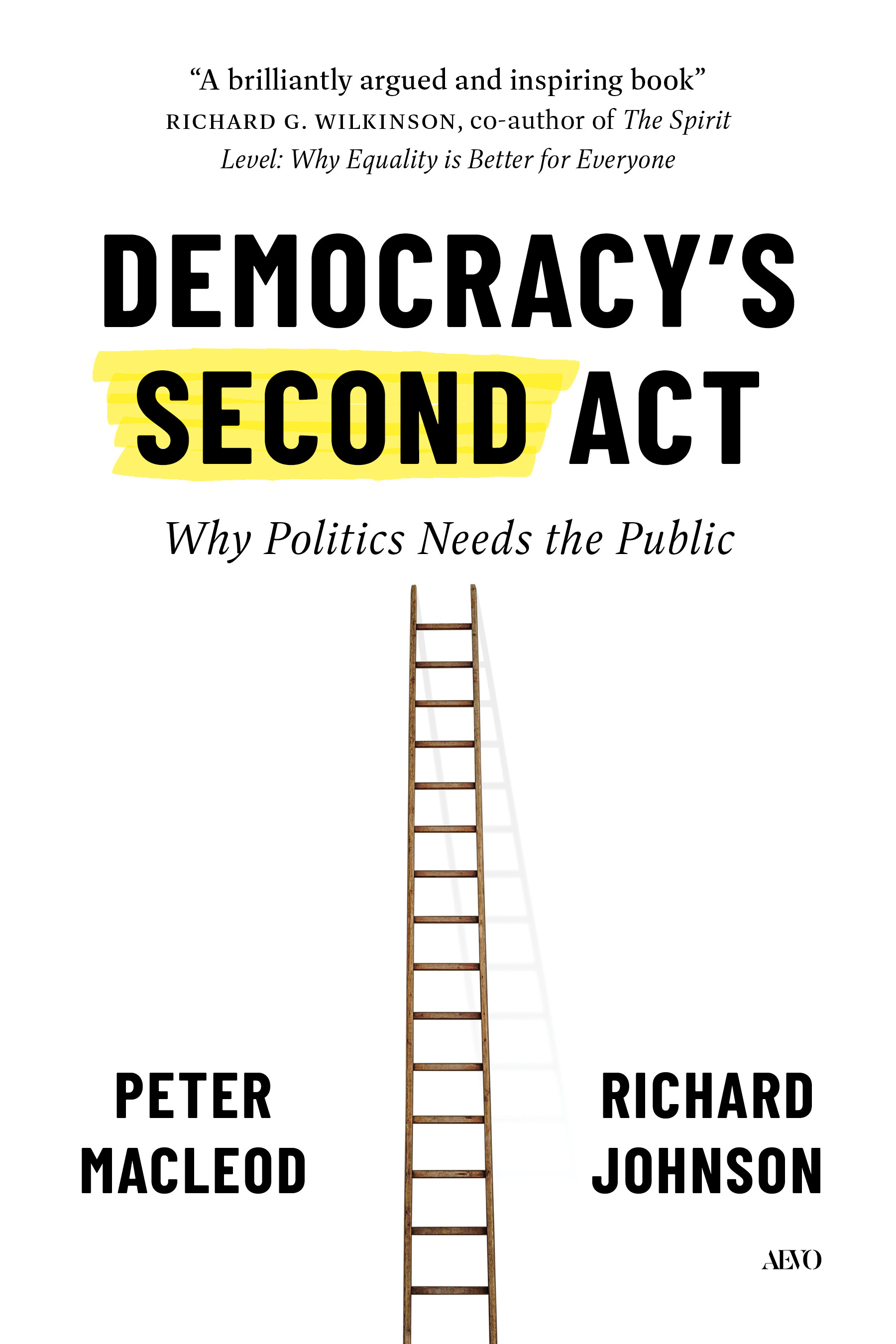
In Democracy’s Second Act: Why Politics Needs The Public, Peter MacLeod and Richard Johnson offer a frank and productive assessment of the state and future of how we govern ourselves — one that emphasises the we. The book is full of examples of how a greater role for the public in governance can revitalize self-government and keep it, and us, around and kicking for many years to come. It’s honest, but hopeful, blending theory and practice.
To save democracy, I spoke to the authors by Zoom.
David Moscrop
I’m going to start with an easy question. I’ll start with you, Peter: Is democracy dying or is it evolving. Or both?
Peter MacLeod
I think it depends where you look. Right now we see lots of morbid symptoms, and part of the reason we wrote the book is because we think the rumours of democracy’s demise are probably greatly exaggerated, but there’s no sticking with the status quo. And one of the things that we’ve learned from our work is that democracy can evolve if we think a little bit differently about the public and what they’re capable of.
Moscrop
Larry Diamond has written about a democratic deficit. There’s lots of writing about democratic decline. I think back to the First World War, a period during which there weren’t many democracies. When we have a long period of democratization after the Second World War. And then the decolonial period. And I think that’s induced in people this sense that democracy is inevitable. But I also think that leads to complacency. Are we being complacent?
MacLeod
We’re being completely complacent, but I think you’re right to acknowledge the slow pace of our democratic evolution. And because it evolves slowly and in fits and starts, it can seem as though the democracy we have today is the democracy we’ve always had. But you don’t have to look any further than Canada’s parliament and its bicameral legislature to note that we actually have two ideas of democratic legitimacy from two different eras baked into the same institutional structure. We have our Senate and we have our elected commons. I don’t think any of us can believe that this is the final state of what democracy can achieve. So we need to be thinking about different kinds of institutional reforms that follow the trajectory we’ve long been on, which means opening up more opportunities for voice, for agency and for participation in the work of democracy
Moscrop
Richard, you write about the two acts of democracy. The first one I think people will be more familiar with than the second. What are those they?
Richard Johnson
We talk about how democracy has been developing on the current trajectory that we think is inevitable. In the work that Peter and I have done over the last number of years, we were seeing something quite a bit different from what we ended up calling the first act: representative democracy, voting and elections, choosing those who represent us and trying to hold them to account. Obviously, the first act has offered up some great gains, certainly in the pursuit of universal suffrage, more equality, and understanding the importance of elections and shaping how we govern ourselves. But there was this other piece, this piece involving members of the public working together.
In our work, we see the second act when it comes to citizens assemblies, when it comes to public forums where people were given the chance, they were given a mandate, they were given time and space to learn together, and they were given a question to wrestle with, to weigh, and ultimately to produce something along the lines of policy recommendations for public consideration. This seemed to be a different state of being a democratic society than the traditional things we’ve come to know. The second act is this piece beyond elections. It’s more about engaging the public.
Moscrop
Speaking of, do we need elections?
Johnson
Well, that’s a fair question. And I know that some people in the democracy space wonder if we need elections if democracy is grinding itself into the ground by relying on the same old framework. But we came to look at it from another perspective, which is that obviously there are roles to play for public servants and for politicians. But at the same time, it feels like democracy needs a lot more of the public, a lot more of the selected people in its work rather than just the elected.
We’ve come to look at it as a bit of a ‘one needs the other’ in order to build back trust, in order to build back hope, and in order to actually do the work of governing. So, we didn’t quite move as far as saying we don’t need politicians, but we do need to hold them to better account, and we do need them to make space for the public and to think about governing in a completely different way.
Moscrop
Democracy’s second act is premised on deep public engagement. That asks a lot of people. It also assumes and requires capacities I think some people might doubt day-to-day citizens possess. Peter, you challenge that notion. Is the public equipped for what the second act asks of them?
MacLeod
Absolutely. But first I want to say that we absolutely need elections and we absolutely need elected representatives. But if you look at the long arc of our democratic evolution, the reality is that while we gave everyone the vote, we haven’t appreciably increased the number of people in our society who actually get to — I’m going to use some choice words here — enjoy the happy burden of representing others. We haven’t created appreciably more seats at the table where people get to do the work of trying to accommodate different viewpoints and translate that into political action. And yes, we can talk about public engagement in the second act, but really it’s about harnessing the public’s capacity for problem solving.
You’ll be well familiar with the line about the how the worst case for democracy is a 10-minute conversation with the average voter. And then William F. Buckley comes along and says, ‘Hey, I’d rather be governed by the first 2000 names in the Boston phone book than the collective faculty of Harvard’.
Moscrop
Thinking of Harvard these days that sounds pretty prescient.
MacLeod
Well, these lines really exemplify the tension between a technocratic view and a populist view. And maybe predictably as Canadians looking at the question of democracy, we want to argue for a third way that increases the capacity of the public to play that role alongside experts and afford them the status to step into the role of representative. But in the day-to-day work of policy making, often our public-sector executives actually feel a bit alone without a way to connect into publics that they are trying to serve.
To your point about the Second World War, though, that was a period in which governments had to invest dramatically in upskilling their populations. It was a period that coincided with major investments in adult education, but a form of education that privileged the arts and sciences and critical thinking, the humanities in effect. We have stepped away from that, and that’s why we think about a second act agenda as fundamentally being about creating informed, productive and engaged publics. It’s not enough just to go asking more and more people for more and more ideas.
Moscrop
Can’t ChatGPT, just do it?
MacLeod
I think there are a lot of people who would like to hand this over to AI, and one of the alarming trends is public opinion researchers who think that by creating ever more sophisticated algorithms that they’re going to be able to put the public on a chip and take us even further out of the loop. And that is a dead end for democracy.
Moscrop
Richard, how do you scale up and institutionalize practices of democratic self-government? Because that work strikes me as more than a technical or organizational challenge. It’s also a political challenge because you’ve got to get politicians to do something they hate doing, which is give up power or control.
Johnson
Those are very practical and real barriers. Part of how we came to look at this issue was starting with trust and how people feel that they can’t trust government, they don’t trust their politicians, they don’t trust the system as they see it. And we obviously see this in the numbers and the research that many have done. We flipped that around based on what we were seeing, which is that it’s not just that people don’t trust their government, it’s the government doesn’t even fundamentally trust their own people.
Client management is what government is able to do: providing services, managing issues, weighing competing interests, serving, the majority, and moving on. But the trust piece is critical. We need our governments to demonstrate trust again, to put their money where their mouth is, to put it into practice and yield space. So, what it takes to scale this up and out and make it practical is sharing that this work creates opportunities not just for us to trust our government, but for our governments to trust us. That’s obviously going to take political capital, and it’s going to take financing. In the book, we argue for democratic action funds, where governments would set aside even just 5% of the cost of running an election and park that into a separate budget to fund some of these initiatives in a sustained way. That would then level up the opportunity to scale them, embed them, and build whole new institutions where they then can work.
Moscrop
Peter, can you offer examples of where these practices work currently?
MacLeod
To pick up on the point around control, part of the challenge is that politicians have to stop pretending they have half as much control as they do. What we’ve seen in jurisdictions like France and Belgium and Ireland where they have used citizens assemblies in a more institutionalized way is that they’re able to tackle topics that are apparently polarizing, to find durable consensus, and then translate that into a legislative mandate that isn’t undone by the next guy who takes the big chair. So, we have mechanisms that allow us to address topics that seemingly have been out of reach for conventional political management.
We talk about a number of ideas in the book for this. We talk about the use of service ballots, a second ballot that electors are given that allows governments to create a pool of volunteers it can call on in the space between elections to take up public appointments to serve on public committees, to attend public meetings, and to volunteer for local initiatives. We think service ballots are a great way to conjoin the idea of voting for a representative while also stepping forward yourself and taking responsibility to be a more engaged participant in local life.
We have also pointed to democratic action funds, which Richard has mentioned, because of course we need to institutionalize this work and that will require resources. We talk about full suffrage, that is eliminating the voting age and making sure democracy is a practice that anyone who feels ready to exercise their franchise is able to do so. We talk about the use of civic lotteries to break up the phenomenon of the usual suspects often being the ones who take the seat at the table when a seat gets set. All in all, we list about a dozen mechanisms that we see being used in different parts of the world that we think anticipate a lot of what democracy’s second act can include.
Moscrop
I want to close out on this question for each of you. Peter, I’ll stay with you and then I’ll give the final word to Richard. When you were finished writing this book, were you left more or less hopeful about the future of democracy in Canada and around the world?
MacLeod
I finished the book feeling clearer about the challenges that we face. I think democracies throughout history have been intensely susceptible to demagogues. That’s the warning from the ancients and throughout history. Subsequently, though, one of the big things we’ve been wrestling with in the course of the past 30 or 40 years has been the advent of a theory of public administration called new public management, born of — let’s give it credit for some worthy ideas — greater efficiency, greater accountability, and greater transparency in the provision of public services.
I’ve long thought that the problem was that new public management redefined citizens as clients. I’ve since come to believe that maybe the bigger problem is that it is focused on delivering things to people rather than actually working with people to create public goods and public value. And so it has codified the idea of the public as a recipient, as a beneficiary rather than as a partner. In the book, we point to examples of how we can unlock massive public value by redefining how we think about and work with the public. If we do that at scale, then many of the challenges we see in democracy today start to go away. But we can’t just look to the public sector to solve these problems. We also need a generation of political leaders who see the public differently and create political parties that aren’t there to cater to segments of the population, but that are there to work with that population for the benefit of all.
Moscrop
And you, Richard?
Johnson
The process of creating, writing and finishing this book left me feeling a lot more optimistic and hopeful. Being able to connect the work that’s been done with citizens assemblies, with the work that’s done by independent groups of people who sponsored Syrian refugees, with stories of what happened in Germany with Holocaust remembrance happening at community levels rather than the big national scale, produced a lot of optimism.
There are a lot of other stories like this in the book and by the end of it we were feeling like there is a thread that weaves through this. There is a faith in the public that is not just a blind faith, but a very practical and tangible one. And so in some ways, finishing the book was more than just a catharsis. It was a renewal of faith for us. That’s the energy we leave and hand over to our readers to ask, Do you agree? And we’ll see what they think.
Johnson proposes a "Democratic Action Fund" pegged at 5% of election costs. Let’s look at the real numbers for Canada. The 2021 federal election cost taxpayers about $632 million. Under this plan, Parliament would have had an extra $31 million just to organize citizens’ assemblies. That is enough money to run a major policy forum in every single riding. It shows that the barrier isn't a lack of money. It is a lack of political will.
I am so delighted to see you interviewing that authors of this book! I've been interested in this topic for years, ever since learning about The People's Platform experiment in Hamilton some twelve years ago -- it's not a Citizens' Assembly per se, but it does represent a more participative form of democracy, one in which people come together to discuss issues that matter to them. Since then, I've read Dave Meslin's "Teardown.Rebuilding Democracy from the Ground Up", and followed his work, as well as your own "Too Dumb for Democracy?". And I've also followed everything I could find on Citizen Assemblies. A couple of years ago, I had the good fortune to be part of the Ontario Priorities Panel on Primary Care, a nation-wide project of citizen assemblies led by Peter MacLeod, culminating in the OurCare report on primary care. It was exhilarating to experience the kind of people's democracy I've always believed possible. So -- now to buy the book!